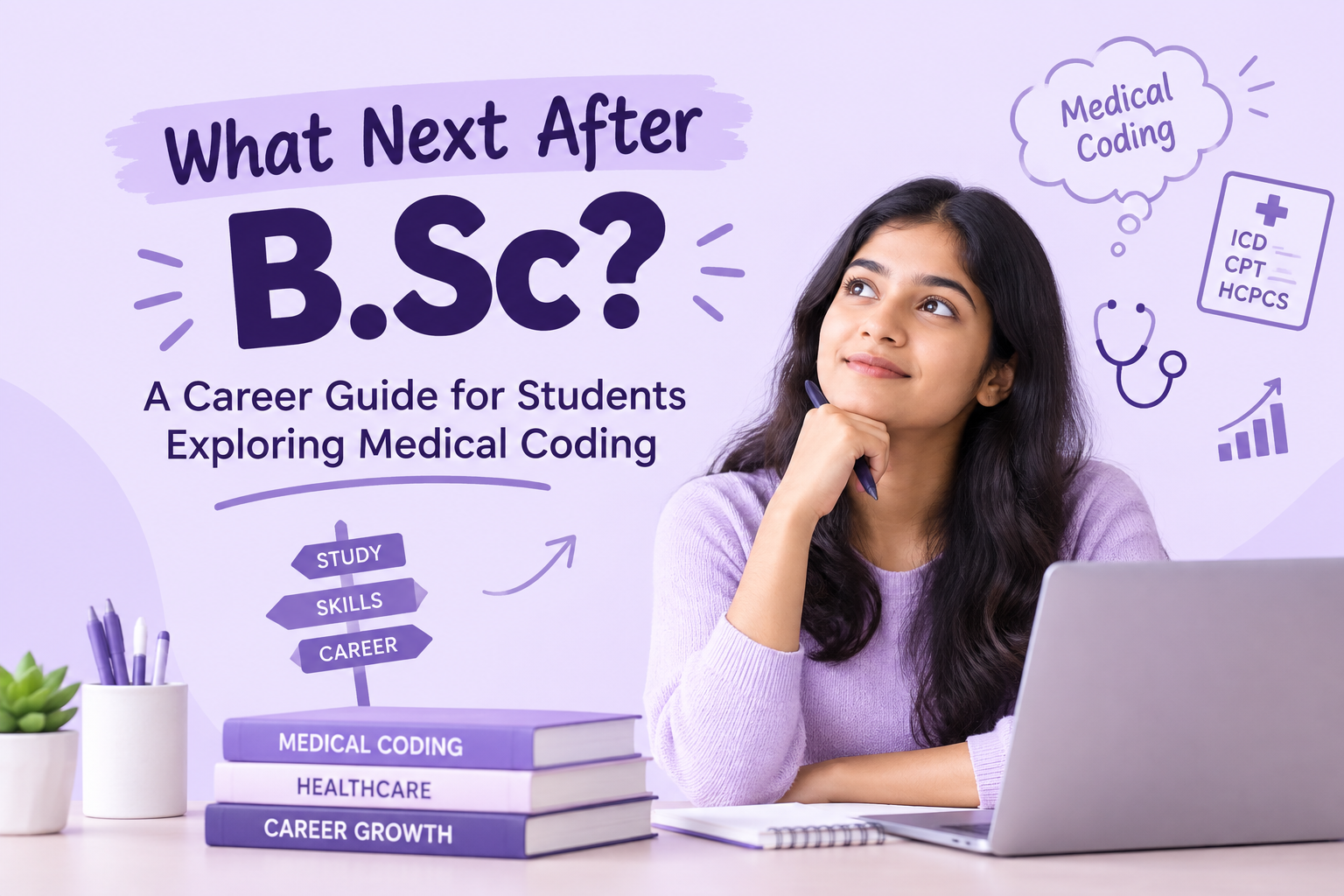
Completing a B.Sc degree is an important milestone, but for many graduates, the next question can be challenging: “What should I do after B.Sc?” Some students consider higher studies, while others start searching for jobs but struggle to identify a career that matches their education and interests.
If you are a B.Sc graduate looking for career options after graduation, medical coding is one healthcare career pathway worth exploring. With the right knowledge, practical training and professional development, students from relevant life science and healthcare backgrounds can build skills for opportunities in the healthcare industry.
Why Are B.Sc Graduates Confused About Their Career?
A degree provides an academic foundation, but students may not always have a clear understanding of the different career paths available after graduation. Many fresh graduates search for jobs after B.Sc, only to find that employers are looking for specific technical or industry-related skills.
Some common challenges include:
- Limited awareness of industry-specific career options
- High competition for entry-level jobs
- Lack of practical, job-oriented skills
- Uncertainty about whether to pursue higher studies
- Difficulty identifying a career aligned with their educational background
Instead of choosing a career randomly, graduates can explore different industries and identify the skills required for their preferred career path.
One such option is medical coding.
Can B.Sc Graduates Choose Medical Coding?
Yes, graduates from relevant educational backgrounds can explore medical coding, depending on the requirements of the training program, certification body and employer.
Students from backgrounds such as:
- Biotechnology
- Microbiology
- Biochemistry
- Life Sciences
- Allied Health Sciences
- Other relevant healthcare or biology-related fields
may find their academic knowledge useful when learning medical terminology, anatomy, physiology and healthcare documentation.
If you are searching for medical coding after B.Sc, understanding the eligibility requirements and career expectations is an important first step.
Why Consider Medical Coding After B.Sc?
One of the major advantages of exploring medical coding is that it provides a way to develop specialized healthcare industry skills after graduation.
For students looking for career options after B.Sc Life Science, medical coding can provide exposure to areas such as:
- Healthcare documentation
- Medical terminology
- Diagnosis and procedure coding
- Healthcare revenue cycle processes
- Medical billing and coding concepts
- Healthcare data and compliance processes
Professional certifications can also help learners demonstrate their knowledge and coding skills. Certifications such as CPC (Certified Professional Coder) are widely recognized in the medical coding field, although students should always check current eligibility and certification requirements before choosing a pathway.
What Skills Are Required for a Medical Coding Career?
Students interested in becoming a medical coder should develop a combination of medical knowledge, coding knowledge and professional skills.
Important areas include:
1. Medical Terminology
Understanding commonly used medical terms makes it easier to interpret healthcare documentation.
2. Anatomy and Physiology
A strong understanding of the human body helps students understand diagnoses and procedures.
3. ICD-10-CM
Students need to understand how diagnosis codes are structured and applied.
4. CPT and HCPCS
Knowledge of procedure and service coding systems is important for many coding roles.
5. Attention to Detail
Medical coding requires careful review of documentation and accurate code selection.
6. Analytical Skills
Coders need to interpret documentation and apply coding guidelines appropriately.
7. Communication and Computer Skills
Basic computer knowledge and professional communication skills can support day-to-day work and workplace collaboration.
How to Start a Medical Coding Career After B.Sc?
If you are considering medical coding courses after B.Sc, you can follow a structured approach:
Step 1: Understand the profession
Learn what medical coders do and understand the different career opportunities.
Step 2: Build your medical foundation
Study anatomy, physiology and medical terminology.
Step 3: Learn medical coding
Develop knowledge of ICD-10-CM, CPT, HCPCS and relevant coding guidelines.
Step 4: Gain practical experience
Practice coding scenarios and healthcare documentation to improve accuracy.
Step 5: Explore certification
Research suitable professional certifications and their current requirements.
Step 6: Prepare for employment
Develop your resume, communication skills, interview skills and job-search strategy.
This approach can help fresh graduates move from degree completion to career preparation in a more structured way.
Medical Coding Career Growth
A medical coding career can develop in different directions depending on a person’s skills, experience, specialization and professional development.
A possible career pathway can include:
Medical Coding Fresher → Medical Coder → Senior Medical Coder → Specialized Coding Roles → Quality, Audit or Team-Level Roles
Career progression varies between organizations, so students should focus on continuously improving their coding knowledge, accuracy and industry skills.
Medical Coding or Higher Studies After B.Sc?
There is no single career path that is right for every graduate. Some students may prefer postgraduate education, while others may want to develop industry-specific skills and explore employment opportunities.
When deciding what to do after B.Sc, consider:
- Your career interests
- Long-term goals
- Financial situation
- Time available for education or training
- Skills you want to develop
- Career opportunities in your preferred field
Researching different options before making a decision can help you choose a path that fits your individual goals.
Frequently Asked Questions
Is medical coding a good career option after B.Sc?
Medical coding is one healthcare career option that relevant B.Sc graduates can explore. Career opportunities depend on qualifications, skills, certification, experience and employer requirements.
Can B.Sc Life Science graduates learn medical coding?
Students from relevant Life Science backgrounds can explore medical coding and develop skills in medical terminology, anatomy, physiology and coding systems.
Do I need certification to become a medical coder?
Certification requirements vary by employer and career pathway. Professional certifications such as CPC can demonstrate coding knowledge, but students should verify current requirements before applying.
What is CPC certification?
CPC stands for Certified Professional Coder. It is a professional medical coding credential offered by AAPC and is commonly associated with professional coding careers.
Conclusion
Completing your B.Sc does not mean your career options end with the jobs directly related to your degree. It can be the starting point for exploring new industries and developing specialized skills.
If you are asking “What next after B.Sc?”, take time to research different career options, understand the skills employers require and identify a pathway that matches your goals.
If you are ready to turn your B.Sc qualification into a new career direction, start your medical coding journey with MedTech Career today.
Your degree gave you the foundation. Let MedTech Career help you build the next step of your career.