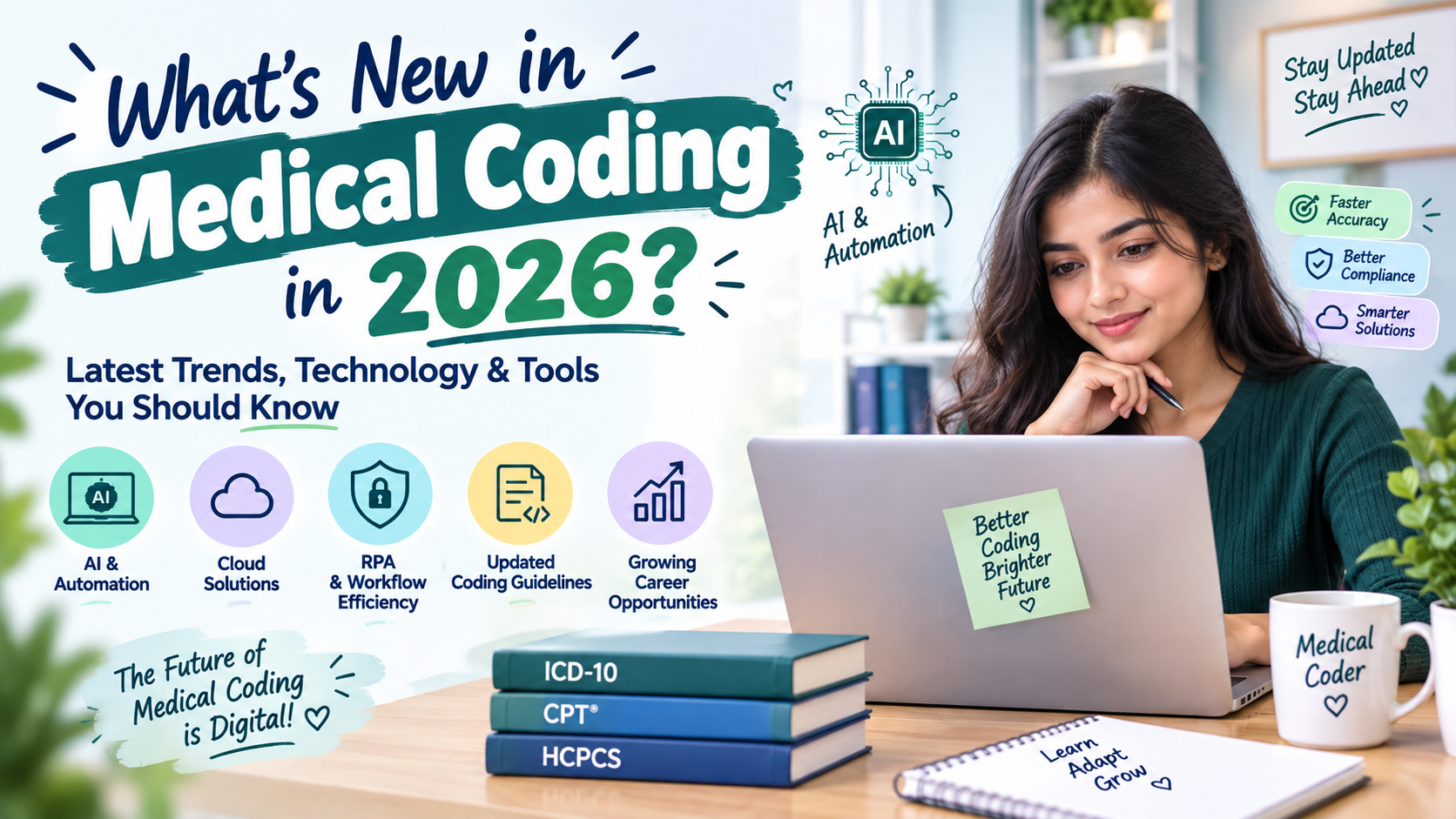
The healthcare industry is changing rapidly, and medical coding is changing with it. New healthcare technologies, artificial intelligence, digital health services and regular coding updates are creating new challenges and opportunities for medical coders.
If you are searching for the latest medical coding trends in 2026, it is important to understand how technology is influencing coding workflows and why continuous learning has become an essential part of a medical coding career.
From AI in medical coding to updated ICD-10-CM and CPT code sets, the role of a medical coder is becoming increasingly connected with technology while still requiring human knowledge, judgment and accuracy.
1. AI Is Changing Medical Coding
One of the biggest medical coding trends in 2026 is the growing use of artificial intelligence and automation.
AI-powered healthcare tools can assist with tasks such as reviewing documentation, identifying potential codes, checking data and supporting coding workflows. The American Medical Association has also continued developing its CPT framework for reporting clinical AI and augmented intelligence applications.
However, AI does not mean that medical coders are no longer important.
Medical coding requires understanding clinical documentation, coding guidelines and the context of a patient’s condition or procedure. Technology can assist with repetitive tasks, but trained professionals are still needed to review information, identify issues and ensure coding accuracy.
For aspiring coders, this means AI and medical coding skills are becoming increasingly relevant.
2. Automation Is Becoming Part of the Coding Workflow
Automation is another important trend in medical coding and healthcare RCM.
Healthcare organizations are increasingly using software to support repetitive processes and improve workflow efficiency. Automated tools may help identify documentation patterns, suggest codes or flag potential inconsistencies for review.
The future of medical coding is therefore less about choosing between humans and technology and more about understanding how both can work together.
Medical coders who develop strong coding fundamentals while learning how technology supports the coding process can better adapt to changing workflows.
3. ICD-10-CM Updates Remain Essential
Medical coders cannot rely on outdated coding knowledge. ICD-10-CM is regularly updated, and coders need to stay familiar with the current code set and official guidelines.
For FY 2026, the CDC released updated ICD-10-CM materials, including an April 1, 2026 update.
CMS also provides the latest ICD-10-CM and ICD-10-PCS files and has released the FY 2027 updates effective from October 1, 2026.
This makes ICD-10-CM coding updates an important part of professional development for medical coders.
A good coder should develop the habit of checking official updates instead of depending only on older study materials.
4. CPT Is Evolving With Modern Healthcare
The CPT code set is also evolving as new medical procedures, technologies and services become part of healthcare.
The AMA’s CPT 2026 release included 288 new codes, along with revisions and deletions. The 2026 code set also included updates related to digital health services, remote patient monitoring and augmented intelligence.
This shows why understanding CPT coding requires continuous learning.
Medical coders should regularly review code-set changes, guidelines and official resources to ensure they are working with current information.
5. Digital Health Is Creating New Coding Considerations
Digital healthcare continues to expand, including services such as remote patient monitoring and technology-supported care.
The CPT 2026 code set introduced new codes for shorter-duration remote monitoring services, reflecting changes in how healthcare data can be collected and used outside traditional clinical settings.
As healthcare becomes more digital, medical coders may increasingly encounter documentation related to technology-enabled services.
This makes digital health and medical coding an important area for professionals who want to understand the future of healthcare.
6. Coding Accuracy Is More Important Than Ever
Technology can make coding workflows faster, but speed should not replace accuracy.
Medical coding affects healthcare documentation, claims and revenue cycle processes. Incorrect code selection or failure to follow coding guidelines can create downstream issues.
The official FY 2026 ICD-10-CM guidelines emphasize the importance of complete and accurate documentation, code assignment and reporting.
For this reason, medical coding accuracy remains one of the most important skills for both beginners and experienced coders.
7. Medical Coders Need Technology Skills
The modern medical coder does not only need knowledge of ICD-10-CM, CPT and HCPCS.
Technology skills are becoming increasingly useful. Depending on the workplace, coders may interact with:
- Electronic health records
- Coding software
- Computer-assisted coding tools
- Healthcare information systems
- Digital documentation platforms
- Quality and productivity dashboards
- Communication and workflow applications
Developing basic digital skills can therefore help aspiring professionals adapt to modern medical coding jobs.
8. Continuous Learning Is Becoming a Career Requirement
One of the biggest lessons from current medical coding trends is that learning does not stop after completing a course or certification.
Coding systems, guidelines, technology and healthcare practices continue to change. Professional coders need to keep themselves updated through official coding resources, continuing education, workplace training and practical experience.
For students planning a medical coding career in 2026, learning how to adapt can be just as important as learning the codes themselves.
What Skills Should Aspiring Medical Coders Develop in 2026?
If you want to build a career in medical coding, focus on a combination of traditional coding knowledge and modern workplace skills.
Important areas include:
- Medical terminology
- Anatomy and physiology
- ICD-10-CM
- CPT
- HCPCS
- Medical documentation
- Coding guidelines
- Healthcare revenue cycle management
- Computer skills
- Analytical thinking
- Attention to detail
- Understanding of AI-assisted workflows
- Communication skills
Professional certification can also be explored depending on your career goals and employer requirements.
What Is the Future of Medical Coding?
The future of medical coding is likely to involve greater interaction between healthcare professionals and technology.
AI, automation and digital health tools can support coding workflows, but the need for people who understand clinical documentation, coding rules and quality requirements remains important.
Rather than viewing technology only as a replacement for traditional coding work, aspiring coders can learn how technology is used as a tool within the healthcare revenue cycle.
The most valuable approach is to build strong fundamentals first and then develop the ability to work effectively with evolving technologies.
Conclusion
Medical coding in 2026 is becoming more technology-driven, but the fundamentals remain important. ICD-10-CM, CPT, HCPCS, medical terminology, documentation and coding guidelines continue to form the foundation of the profession.
At the same time, AI in medical coding, automation, digital health and computer-assisted coding are changing how coding work can be performed.
If you are planning to start a medical coding career, now is the time to build both strong coding knowledge and technology awareness.
At MedTech Career, students can develop medical coding fundamentals, gain practical exposure and prepare for the evolving healthcare industry with structured learning and career guidance.
Ready to build your medical coding career? Start your journey with MedTech Career and prepare for the changing world of healthcare.